
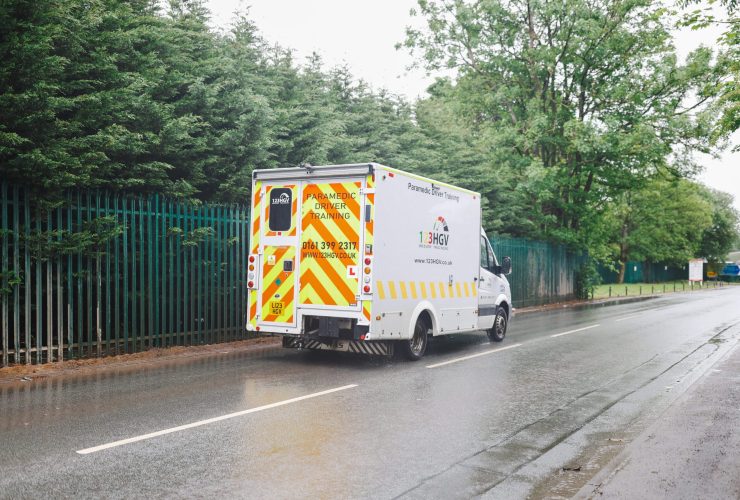
Many people interested in working for the NHS or private ambulance services ask the same question: can I become an ambulance driver without a C1 licence?
The short answer is usually no. Most ambulance vehicles used in the UK weigh over 3.5 tonnes, which means drivers must hold a C1 licence to drive them legally.
If you passed your car driving test after 1997, you will normally need to obtain a 7.5 tonne C1 licence before you can drive an ambulance as part of your job.
Why Ambulance Drivers Need a C1 Licence
Ambulances are built on large van chassis that typically weigh between 3.5 tonnes and 7.5 tonnes once fully equipped with medical equipment and patient support systems.
This places them in the C1 vehicle category, which allows drivers to operate vehicles between 3,500kg and 7,500kg.
Because of this weight classification, most NHS Trusts and private ambulance providers require drivers to hold a valid C1 licence before they can operate these vehicles.
You can learn more about the qualification through our C1 licence training programmes.
Do Some People Already Have a C1 Licence?
Yes. Drivers who passed their car test before January 1997 often automatically received C1 entitlement on their licence.
This means they may already be legally allowed to drive vehicles up to 7.5 tonnes without additional training.
However, many younger drivers do not have this entitlement and must complete training and testing to obtain the licence.
How to Get a C1 Licence for Ambulance Driving
If you do not already hold C1 entitlement, you will normally need to complete the following steps:
- Apply for provisional C1 entitlement
- Complete a driver medical
- Pass the LGV theory test
- Complete practical C1 driver training
- Pass the DVSA practical driving test
Once you hold a C1 licence, you can legally drive vehicles up to 7.5 tonnes, including ambulances and many specialist emergency vehicles.
You can explore available courses through our C1 licence training programmes.
Do Ambulance Drivers Need Driver CPC?
In many cases, ambulance drivers working professionally will also need to complete Driver CPC Module 4, particularly if they operate vehicles as part of commercial or contracted transport services.
This qualification demonstrates that drivers understand vehicle safety, load security and professional driver responsibilities.
Training and testing is available through our CPC Module 4 training programmes.
C1 Training Locations Across the UK
If you are planning to become an ambulance driver, C1 training is available at multiple locations across the UK.
You can explore training options in locations such as:
- C1 licence Blackpool
- C1 licence Birmingham
- C1 licence Leeds
- C1 licence Carlisle
- C1 licence Oxford
- C1 licence Portsmouth
These training courses help prepare drivers for the DVSA test and ensure they are confident operating larger vehicles safely.
Other Careers That Require a C1 Licence
While ambulance driving is one of the most well-known careers requiring a C1 licence, it is not the only one.
Drivers with a 7.5 tonne licence may also work in:
- Medical transport services
- Hospital logistics
- 7.5 tonne delivery driving
- Furniture and appliance delivery
- Vehicle recovery services
Because of the flexibility of the licence, many drivers use C1 as a stepping stone toward larger vehicle categories such as Category C (Class 2) or Category C+E (Class 1).
Final Thoughts
If you want to work as an ambulance driver, holding a C1 licence is usually essential.
For drivers who passed their test after 1997, gaining this qualification is often the first step toward working in the emergency services, patient transport or specialist medical driving roles.
If you are considering this career path, obtaining your C1 licence will allow you to legally drive the vehicles used by most ambulance services across the UK.